How to Choose the Best Pneumatic Bending Machine?

Blog

How to Choose the Best Pneumatic Bending Machine?

Choosing the right Pneumatic Bending Machine begins with the workpiece, not the catalog photograph. Sheet thickness, material hardness, bend angle, production volume, and available floor space all influence the decision. A compact workshop may need a smaller frame, while continuous production demands faster cycling and stronger tooling. Small details matter. A poorly matched machine can leave uneven flanges, visible surface marks, or wasted compressed air.

Michael Turner, an experienced sheet-metal forming engineer, explains, “The best Pneumatic Bending Machine is the one that delivers repeatable bends without exceeding the operator’s real requirements.” This practical view deserves attention. Maximum pressure alone does not prove better performance. Buyers should examine bending accuracy, cylinder stability, die compatibility, guarding, noise levels, and maintenance access. Ask for test bends using the actual material. A polished demonstration may hide limitations.

Air quality also matters. Moisture in the pneumatic system can damage valves and reduce response speed. Check the required air pressure, consumption rate, and compressor capacity before ordering. Operator experience should guide the choice too. A machine with simple controls may outperform a more advanced model when training time is limited. That is easy to overlook.

There is no perfect specification sheet. Some published capacities assume ideal conditions, and real production can be less forgiving. Compare verified samples, service support, warranty terms, and replacement-part availability. A careful decision balances productivity, safety, accuracy, and long-term operating cost. The cheapest machine may not remain economical after repeated adjustments, downtime, and tooling changes.
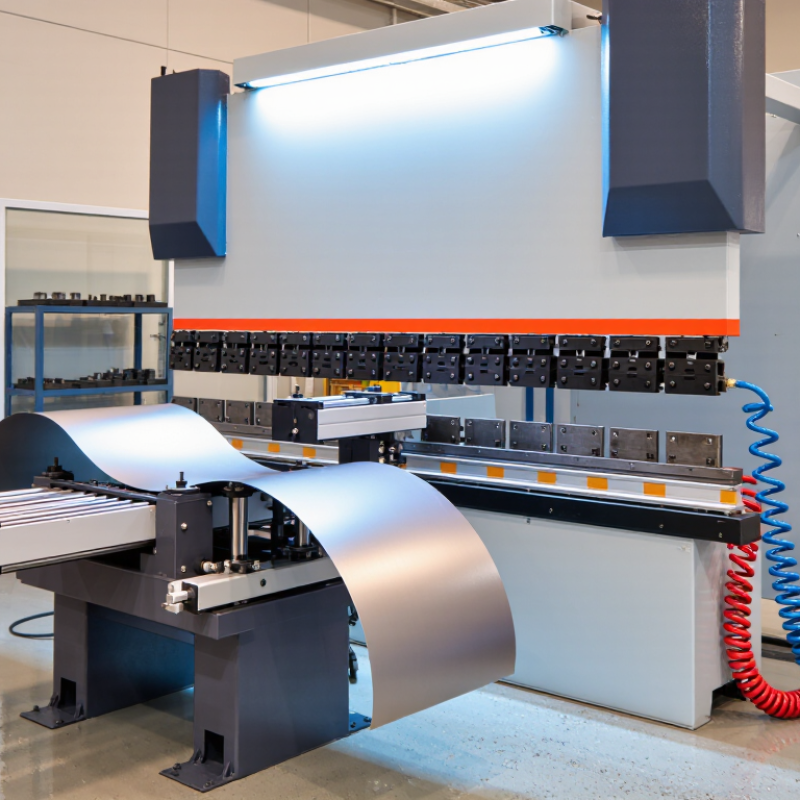
How to Choose the Best Pneumatic Bending Machine?

Define the Workpiece and Bending Requirements

How to Choose the Best Pneumatic Bending Machine?

Define the Workpiece and Bending Requirements

Start with the workpiece, not the machine catalogue. Record the material, thickness, width, length, and required bend angle. Steel, aluminum, and stainless steel react differently under pressure. Their springback can vary noticeably.

Inspect the drawing carefully. Note the inside bend radius, flange length, hole positions, and dimensional tolerances. A small hole near the bend may deform during forming. The first estimate is often wrong. In practice, I have seen operators measure only sheet thickness and overlook grain direction. That mistake caused uneven angles and extra rework.

Production volume also matters. A workshop making ten parts weekly needs different controls from one producing hundreds daily. Check whether the pneumatic system can provide stable force throughout the stroke. Confirm the available air pressure, cylinder capacity, working width, and tooling range. The machine should handle the thickest planned workpiece without operating at its limit. Leave capacity for variation.

Keep the requirement measurable. For example, specify a 2.0-millimeter sheet, a 90-degree bend, a 3-millimeter inside radius, and a tolerance of plus or minus one degree. Test samples with the actual material before final selection. A practical trial may reveal marks, springback, or positioning problems that drawings cannot show. Do not trust assumptions. Record the results and revise the specification when necessary.

Compare Pneumatic Bending Machine Types and Configurations

How to Choose the Best Pneumatic Bending Machine?

Pneumatic bending machines differ mainly in force, frame design, and control method. Air bending uses partial tool contact, so it suits varied angles and quick setup changes. Bottoming applies more pressure against the die, producing consistent angles but requiring stronger equipment. Coining gives excellent repeatability, although it consumes more energy and may mark thin sheets.

A single-cylinder configuration can handle light production and simple profiles. Dual-cylinder systems improve balance across wider workpieces. C-frame machines save floor space, while four-column frames offer better rigidity for repeated bending. Check the working width, maximum sheet thickness, stroke length, and open height before comparing prices. A machine with insufficient stroke may look economical, then limit everyday jobs.

The pneumatic system also deserves close inspection. Match the air compressor to the machine’s pressure and flow requirements. A small tank can cause pressure drops during continuous cycles. Adjustable speed, foot control, emergency stopping, and transparent guarding improve operator control. Digital angle measurement helps, but it cannot correct poor tooling or uneven material. In workshop checks, I would test several sample sheets, not one. Metal thickness often varies slightly, and that small difference can expose weaknesses. My first preference is reliable repeatability, not the highest advertised force. Productivity claims can be optimistic.

How to Choose the Best Pneumatic Bending Machine? - Compare Pneumatic Bending Machine Types and Configurations

Pneumatic Bending Machine Type Typical Working Width Typical Material Thickness Typical Bending Force Common Bending Method Typical Accuracy Best-Suited Materials Main Advantages Key Limitations Recommended Production Volume
Pneumatic Press Brake 1,250–3,200 mm 0.8–3.0 mm mild steel
0.6–2.0 mm stainless steel
250–1,000 kN Air bending with upper punch and lower die Approximately ±0.10–0.30 mm with a calibrated back gauge Mild steel, stainless steel, aluminum, galvanized sheet Flexible tooling, wide range of bend angles, suitable for multiple part sizes Higher initial cost; requires correct die selection and operator setup Medium to high
Pneumatic Box-and-Pan Folder 1,000–3,100 mm 0.6–2.0 mm mild steel
up to approximately 1.2 mm stainless steel
Typically 50–250 kN clamping or folding force Folding beam with adjustable or removable fingers Approximately ±0.20–0.50 mm, depending on setup Thin sheet steel, aluminum, stainless steel, HVAC sheet Good access to three-sided boxes, trays, pans, and enclosures; minimizes tool changes Less suitable for thick plate and very acute bends Low to medium
Pneumatic Rotary Bending Machine 1,000–2,500 mm 0.5–1.5 mm mild steel
0.5–1.0 mm stainless steel
Typically 30–150 kN Rotary forming rolls or eccentric rotary tooling Approximately ±0.20–0.40 mm Thin sheet, pre-painted sheet, aluminum, light-gauge stainless steel Fast repetitive bends, reduced surface marking, smooth edges on light materials Limited thickness range and less flexibility for complex tool geometries Medium to high
Pneumatic U- and V-Bending Press 300–1,500 mm 0.5–2.5 mm mild steel
0.5–1.5 mm aluminum
100–500 kN Dedicated punch-and-die forming Approximately ±0.15–0.40 mm Sheet metal components requiring repeated U, V, channel, or offset profiles Fast cycle times and consistent results for dedicated part geometries Lower flexibility; dedicated tooling is often required for each profile Medium to high
Pneumatic Tube and Pipe Bender Tube length commonly 1,000–3,000 mm Tube wall thickness typically 0.8–3.0 mm Typically 20–200 kN bending force Rotary-draw, compression, or form bending Approximately ±0.5–1.0° bend angle, depending on tooling Steel, stainless steel, copper, and aluminum tubing Suitable for repeatable tube angles and lower-volume fabricated assemblies Requires diameter-specific tooling; not intended for flat sheet bending Low to medium
Pneumatic Edge-Flanging Machine 600–2,000 mm 0.5–1.5 mm mild steel
0.5–1.0 mm stainless steel
Typically 20–120 kN Edge folding, flanging, or hemming with specialized tooling Approximately ±0.20–0.50 mm Thin sheet, ductwork, covers, panels, and enclosure components Compact, fast, and effective for reinforcing or finishing sheet edges Limited to edge operations and relatively light-gauge materials Medium to high
Air-Over-Oil Pneumatic Press Brake 1,500–4,000 mm 1.0–4.0 mm mild steel
0.8–2.5 mm stainless steel
400–1,500 kN Hydro-pneumatic actuation with air-assisted hydraulic control Approximately ±0.05–0.20 mm with suitable controls Mild steel, stainless steel, aluminum, and coated sheet Higher force and smoother motion than a direct pneumatic system; better for heavier work More complex maintenance and higher equipment cost than basic pneumatic models Medium to high
Compact Pneumatic Bench Bender 300–1,000 mm 0.3–1.2 mm mild steel
0.3–0.8 mm stainless steel
Typically 10–80 kN Manual positioning with pneumatic clamping or bending assistance Approximately ±0.30–0.70 mm Thin sheet, small brackets, electrical panels, and prototypes Small footprint, low energy demand, and economical for short parts Limited working length, force, automation, and repeatability Low
CNC Pneumatic Bending Configuration 1,500–4,000 mm 0.8–3.0 mm mild steel
0.6–2.0 mm stainless steel
300–1,200 kN Programmable air bending with CNC back gauge Approximately ±0.05–0.15 mm under stable conditions Mild steel, stainless steel, aluminum, and repeat-production sheet Fast setup, multi-step programs, improved repeatability, and reduced operator variation Higher purchase price; requires programming, calibration, and skilled maintenance High

Note: The figures are typical engineering ranges for pneumatic or air-assisted sheet-metal bending equipment. Actual capacity depends on material grade, bend length, die opening, tooling design, air pressure, machine frame, and operating conditions.

Evaluate Capacity, Precision, Speed, and Control Features

Choosing a pneumatic bending machine requires more than checking its maximum tonnage. Match capacity with material thickness, bend length, and daily workload. A machine rated for 100 tons may struggle with wide stainless-steel sheets. Ask for a clear load chart, not a headline number.

Precision depends on frame rigidity, cylinder balance, tooling quality, and measurement feedback. Check repeatability figures under real production conditions. ISO 230-1 provides a useful framework for evaluating machine-tool accuracy. Small angle errors can become visible gaps in a cabinet corner. I would test several bends after the machine reaches operating temperature. Cold-start results can be misleading.

Speed matters, but uncontrolled speed creates waste. The International Federation of Robotics reported 541,302 industrial robots installed worldwide in 2023, showing the industry’s shift toward connected automation. Choose proportional valves, programmable pressure settings, position feedback, and simple diagnostics. These controls can reduce adjustment time between batches. They should still be easy for operators to understand. Complex screens are not always intelligent.

Tips: Compare cycle time at your actual stroke length. Request sample bends using your material. Record angle variation across ten repeated parts. Review emergency-stop access and guarding against applicable safety standards. Ask how quickly technicians can replace seals and recalibrate sensors. A faster machine may look impressive, yet a slower unit with stable accuracy can deliver more usable parts.

Check Safety Systems, Maintenance Needs, and Operating Costs

How to Choose the Best Pneumatic Bending Machine?

Safety systems deserve more attention than a polished brochure. Check fixed guards around pinch points, emergency stops, two-hand controls, and pressure regulators. The control circuit should support risk assessment under ISO 12100 and safety-related control design under ISO 13849-1. Do not accept a button that merely looks compliant. Test whether the machine stops before an operator can reach the tooling. In a real workshop, gloves, poor lighting, and hurried setup can expose weaknesses that factory demonstrations hide.

Maintenance needs are equally practical. Ask whether filters, drains, seals, and hoses are easy to inspect without removing major panels. The U.S. Department of Energy’s Improving Compressed Air System Performance guide reports that leaks can waste 20–30% of compressor output. That waste appears as higher electricity bills and unstable bending force. DOE guidance also notes that compressed air can represent roughly 10% of industrial electricity use. Track air pressure, cycle time, and leak rates monthly. Small deviations matter. A neglected filter can create large problems.

Operating cost is more than the purchase price. Compare air consumption per cycle, compressor loading, spare-part access, service intervals, and expected downtime. A cheaper machine may become expensive after repeated seal failures. I would request measured energy data, not optimistic estimates. Some published figures are difficult to verify. That is a weakness worth questioning. Test several material thicknesses, record actual air use, and calculate cost per finished bend before approving the purchase.

How to Choose the Best Pneumatic Bending Machine?

Compare typical planning benchmarks for safety coverage, annual preventive-maintenance time, and compressed-air consumption. Actual figures vary by machine capacity, duty cycle, tooling, and workplace regulations.

Higher safety coverage is preferable, while lower maintenance hours and compressed-air consumption generally indicate lower long-term operating requirements. Verify guarding, emergency stops, interlocks, inspection access, and supplier maintenance procedures before purchase.

Select the Best Machine for Your Workspace and Production Goals

Choosing the best pneumatic bending machine starts with your workspace, not a catalog. Measure floor area, door clearance, bench height, and compressor location. A compact machine may fit neatly, but limited throat depth can restrict larger panels. Leave room for loading material safely. Fit matters. I once underestimated side clearance, and moving finished parts became awkward. That mistake changed how I evaluate layouts.

Match the machine’s capacity to your real production goals. Record material type, thickness, bend length, daily volume, and required angle consistency. Check rated force, stroke, working width, die options, and adjustment range. Aluminum, mild steel, and coated sheets behave differently under pressure. Ask for test bends using your actual material. A clean sample is useful, but repeatability matters more than one impressive bend. Also confirm that the compressor can maintain pressure during continuous cycles. A weak air supply causes slow movement and uneven results.

For a dependable workspace, inspect guarding, emergency controls, foot-pedal design, noise, and operator visibility. Noise matters. Verify that safety features meet applicable workplace requirements. Pneumatic systems need regular checks for leaks, water in air lines, worn seals, and loose fittings. Choose controls that new operators can understand after documented training. Maintenance access should be practical, not hidden behind crowded panels. Review service guidance, spare-part availability, and inspection records before purchase. Production targets can change, so leave modest capacity for future work. Too much capacity, however, increases cost and wastes floor space. Before ordering, ask operators to review the layout beside a full-size workpiece.